How Van Gogh’s ‘The Starry Night’ Mirrors the Mathematics of Turbulence
Scientists find van Gogh’s The Starry Night aligns with Kolmogorov’s turbulence theory, revealing hidden mathematical patterns in its iconic swirls.
Hidden Physics in a Masterpiece
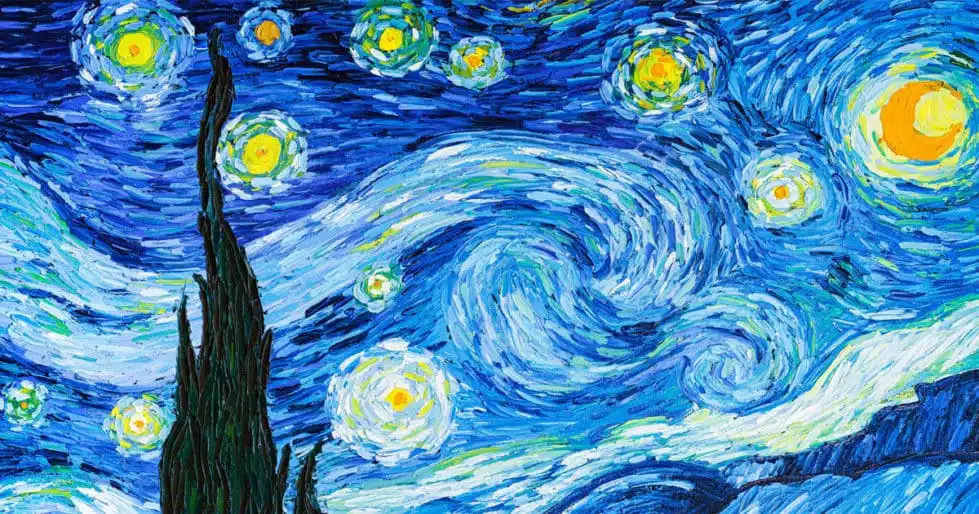
Vincent van Gogh’s 1889 painting 'The Starry Night' is more than a visual marvel. A new study reveals its swirling sky follows the same statistical laws that govern turbulent fluid flow—a hidden mathematical structure that aligns with Kolmogorov’s theory of turbulence and Batchelor’s scaling. Published in Physics of Fluids, the research analyzed the 14 main whirls in the painting using a high-resolution digital image.
How the Analysis Was Done
Researchers measured the scale, luminance, and brushstroke patterns of each eddy in 'The Starry Night.' They compared these measurements to Kolmogorov’s 1940s theory, which describes how energy cascades from large to small eddies, and Batchelor’s scaling, which tracks how small particles disperse in turbulent flow. The team’s innovative use of relative brightness allowed them to assess motion within the static image.
Artistic Intuition Meets Scientific Laws
Van Gogh painted the scene from his asylum room in Saint-Rémy-de-Provence in June 1889, just before sunrise. The turbulent sky reflected his own emotional turmoil, yet the brushstrokes unconsciously captured precise mathematical behavior. The study confirms the 14 swirls adhere to Kolmogorov’s cascade and, at finer scales, Batchelor’s dispersion patterns—a dual alignment that surprised scientists.
Broader Comparisons: Constable and Jupiter
To test universality, the same methods were applied to John Constable’s 1826–27 painting 'Chain Pier, Brighton' and to a 1979 Voyager 1 image of Jupiter’s Great Red Spot. Constable’s clouds exhibit multi-scale structures, while the Jovian storm also follows Kolmogorov’s theory. These comparisons underline that turbulent patterns are fundamental in both nature and art.
Why This Matters for Physics and Art
Understanding turbulence remains a major challenge in physics, with applications in weather prediction and flight safety. That a static painting matches dynamic flow models suggests current statistical tools are more robust than previously thought. This opens the possibility of using art to explore fluid dynamics, bridging disciplines and enriching both scientific theory and artistic appreciation.
Future Directions
The study encourages further interdisciplinary work. Analyzing other artworks may reveal similar hidden patterns, offering new data for turbulence models. It also demonstrates how artistic representations can serve as accessible teaching tools for complex scientific concepts, making the beauty of natural laws visible to the public.
‘The Starry Night,’ held at the Museum of Modern Art in New York, continues to fascinate. This new scientific perspective deepens its legacy, showing that van Gogh’s visionary expression reflects the very laws that shape our world.